Most real assets in Japan come bolted to the land: illiquid, taxed annually, and expensive to exit. A trailer house occupies a different legal category — and for investors, that category is the whole point.
Vehicle, not building — and why it matters
Under guidance from Japan's Ministry of Land, Infrastructure, Transport and Tourism and municipal building authorities, a trailer house that remains "movable at any time" is not a building under the Building Standards Act. The practical tests: wheels and towing gear stay attached, utility hookups are tool-free and detachable, no fixed stairs or decks anchor the unit, and a clear path to a public road exists. Keep those conditions and three consequences follow:
- No fixed asset (property) tax — the annual holding cost that erodes conventional real estate yields simply doesn't apply
- No building permit — placement is possible even on land where construction is restricted, including urbanization-control zones
- Four-year statutory depreciation for business use (as a towed vehicle under Japan's depreciation schedule) — versus 22–47 years for buildings
Mobility is an exit strategy
Illiquidity is the quiet killer of rural property investments in Japan. A trailer house de-risks this in two directions: relocation (move the unit to a stronger location — a new glamping site, a different prefecture) and resale (the unit sells as a vehicle, independent of the land). Exit costs are transport fees, not demolition.
What can go wrong
The vehicle status is conditional, and the final call belongs to each municipality's building authority. Bolt on a fixed deck, hard-plumb the water line, or block the exit path, and your vehicle can be reclassified as a building — with tax and permit consequences. This is an installation discipline, not a loophole: it must be maintained for the life of the asset.
A note for non-resident investors
Japan places no nationality or residency restrictions on owning land or property — foreigners hold freehold title on the same terms as citizens. Combined with historically low rural land prices and a weak yen, the entry ticket to a Japanese leisure asset has rarely been smaller. Operating a lodging business on that land does require the proper license and, depending on your situation, a Japanese business presence — points to close with professionals early.
Sources & further reading
- Municipal guidance on trailer houses under the Building Standards Act: Kisarazu City / Mito City (Japanese)
- Foreign ownership of Japanese real estate — overview: Akiya Japan guide
- Depreciation schedule (towed vehicles, 4 years): Ministry of Finance ordinance on useful lives — available via e-Gov (Japanese)
This article is general information as of September 2026, not investment, legal or tax advice. Confirm all treatments with licensed Japanese professionals for your specific structure and municipality.
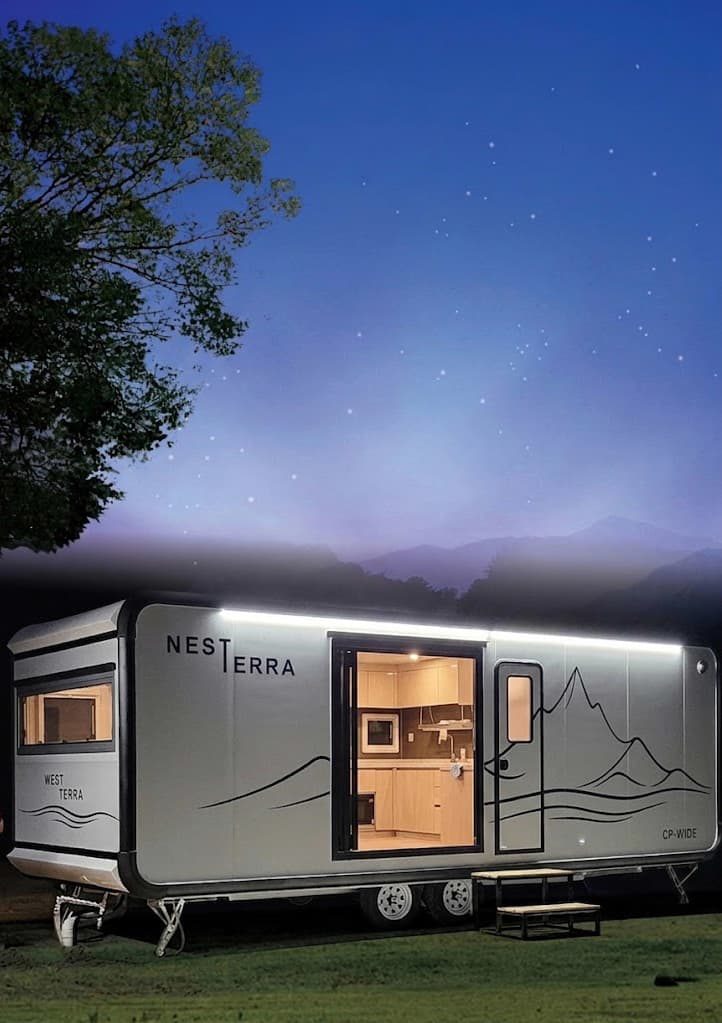
See the asset before you invest.
Spend a free night in our display unit at the Yamami Exhibition Site, Aichi.
We consult with international clients in English.